Showing posts with label business. Show all posts

2023-07-20

Observations on boiling frogs

I've had the recent opportunity to observe a post-COVID concerted attempt by tech leadership to reduce its company's costs, and it has been quite eye-opening. A common theme in employee chat spaces when discussing the changes is the whole boiling frog meme, but I think that a lot of people miss the deeper implications of what's actually going on.

Q: Why do you boil frogs in the first place?
A: You're making frog soup.

When you make frog soup, you can add in lots of other ingredients to change / disguise the taste, but inevitably you will need to have a certain amount of frog to attract customers. Yes, these customers will probably be French, and you'll have to deal with everything that comes along with that, but that is your customer base. Frog soup eaters, who pay you for the soup, want frogs in their soup.

Ah, but how many frogs will there be? You fill the tureen with lukewarm water, drop (say) 100 frogs into it, and turn on the gas cooker. Will you get a 100-frog soup? No!

  • Some frogs will jump out of the tureen, just because they're interested in the wider world - the water temperature means nothing to them.
  • Some frogs are sensitive to heat, and at the first warming sensation they'll try to escape.
  • Once the activity becomes noticeable to the broader frog population, there will be general concern in the tureen, and some frogs will try to jump out just because they notice other frogs jumping out. Generally, you lose the healthiest frogs at this point. The old, sick frogs are stuck.
  • You might try to drop additional frogs into the tureen to replace those lost. Unfortunately, word gets around the frog community fairly quickly, and the larger frogs will squirm out of your hands. You're left with the young frogs who don't know any better.

Eventually, the soup comes to the boil, and you're left with... substandard frog soup. Bon appetit!

2022-12-26

The Twitter Whistleblower report - how bad was Twitter, really?

Prompted by a post by everyone's favourite Portugal-based squirrel-torturing blogger, Tim Worstall, I thought I'd dive into the practical implications of all the (frankly, horrendous) technical, security and privacy problems that Twitter was identified as having before Elon Musk rocked up as owner and CEO.

Usual disclaimer: I'm going by the reports. Reality might be different. I cite where I can.

For background: both USA and European authorities take a dim view of corporate access to, and usage of, individual user data. Remember the European "ePrivacy Directive"? Also known as the "'f+ck these annoying cookie pop-ups' law"... Governments in both Europe and the USA are keenly interested in companies tracking individual users' activities, though my personal opinion is that they're just jealous; they'd like to do it too, but they're just not competent. Anyway, a company doing individual tracking at large scale for profit - Twitter, Google, YouTube, Meta, Amazon - attracts their attention, and their laws.

Security

Let's talk about security - and, more importantly, access to secure data. A fundamental principle of security is "least privilege" - everyone should have the smallest set of access privileges to be able to do their job. You could argue that 5000+ people in Twitter "need" to be able to change things in production at some point to do their jobs, but they certainly don't "need" to have always-on, cross-production access. Not least, because someone running a command they found on an internal playbook as an experiment, could easily break a large chunk of the service. But don't rely on me, ask their job candidates:

Twitter's practice was a huge red flag for job candidates, who universally expressed disbelief. One Vice President of Information Technology [his current role, not the target role] considered withdrawing his application on the (accurate) rationale that Twitter's lack of basic engineering hygiene in their arrangement presaged major headaches.
Hire that guy.

Certainly, every company is far from perfect in this area, but those with regulators are continually seeking to narrow the number of people with access, and the scope of access those people have. Twitter pre-Musk clearly did not give a crap about the count and scope of access. One can only imagine why; were they, for instance, relying on a large base of pre-approved employees to intercept and downgrade/block opinions outside the mainstream? How would we tell if this were not the case? Can Twitter show that they were engaged in a systematic reduction of number and scope of access to production? If not, who will be held to account?

Auditing

Control is one thing - but at least, if a human performs an action in the production environment (change, or query), that action should at least be logged, so future audit can see what happened. This is not a high bar, but was apparently too high for pre-2022 Twitter:

There was no logging of who went into the production environment or what they did.
FFS
To make clear the implications: in general, there was no way of finding out who queried (for their own purposes) or changed (deleted posts, down-rated users, etc) the production environment at any particular time. "Why did [event] happen?" "Beats the hell out of me, someone probably changed something." "Who? When?" "No idea."

This is particularly interesting because Twitter's Chief Information Security Officer - who resigned post-Musk - was also their former head of privacy engineering, and before that, apparently, global lead of privacy technology at Google. One could only imagine what that implies.

Control

There is also a wide range of engineering issues. Data integrity (not losing user-entered data) was obviously a critical issue, but Twitter had been aware for a while that they teetered on the edge of a catastrophic production data loss:

even a temporary but overlapping outage of a small number of datacenters would likely [my italics] result in the service going offline for weeks, months, or permanently.
This is not quite as bad as it first seems. After a year or so in operation, companies have a fairly good idea what happens with a datacenter outage - because they're more frequent than you imagine. Say, Henry the intern accidently leans against the Big Red Button on the datacenter floor, that cuts power to everywhere. Or you do a generator test, only to discover that a family of endangered hawks have made their nest in the generator housing for Floor 2... So you get used to (relatively) small-scale interruptions.

If you want to run a global service, though, you need to be able to tolerate single site outages as routine, and multiple site outages (which turn out to be inevitable) have to be managed within the general bounds of your service's promised availability - and latency, and data availability. Even if all your physical locations are very separate, there will inevitably be common cause failures - not least, when you're pushing binary or config changes to them. So, don't wait for these events to sneak up on you - rather, anticipate them.

This means that you have to plan for, and practice these events. If you're not doing so, than a) it will be obvious to anyone asking questions in this area, and b) when things inevitably do run off the rails, there will be bits of burning infrastructure scattered everywhere, around the highly-paid morons who are busy writing memos to cover their asses: "how could we have foreseen this particular event? Clearly, it wasn't our fault, but pay us 20% extra and we might catch or mitigate the next such event."

Go looking for those people. Fire them, and throw them into a den of hungry pigs.

Leaving the doors open

By far the most horrific aspect, however, was the general relaxed attitude about government agencies - and heaven only knows what other NGOs, cabals, and individuals - having under-the-table access to Twitter's data. Just the tolerance of user-installed spyware on privileged devices would be enough for any sane security engineer to be tearing out their hair, but actually letting in individuals known to be employed by foreign - and even domestic - governments for the purposes of obtaining intelligence information, and potentially affecting the flow of information to their and other countries... one is lost for words.

At some stage, Twitter had to either grow up, or close down. Under Dorsey's crew, the latter was inevitable - and likely not far away. It's still too early to tell if Musk can get them to option 1, but there's still hope.

2022-02-13

Elon Musks' employees might be racist

A Happy New Year to all my occasional readers! May your 2022 be less fucked-up than your 2021, which is probably the best we can hope for.

I was inspired to put pen to... LCD? whatever... reading a breathless Los Angeles Times article on racism and discrimination at Tesla's Fremont, California plant:

4:05 p.m. Feb. 12, 2022: An earlier version of this article said that at least 167 racial and sexual harassment suits were filed against Tesla since 2006. At least 160 worker lawsuits were filed over various grievances, not just harassment.
Oh, sorry, that was an article correction. I'm sure that most of the 160 lawsuits were about racism and sexism. Many, at least. Some, for sure. I wonder why they didn't give a more specific breakdown?

Anyway, let's get on to the meat of the allegations from California's (government) civil rights agency, who are clearly in no influenced by Tesla's move from California to Texas that will take billions of dollars out of their income:

Tesla segregated Black workers into separate areas that its employees referred to as “porch monkey stations,” “the dark side,” “the slave ship” and “the plantation,” the lawsuit alleges.
Only Black workers had to scrub floors on their hands and knees, and they were relegated to the Fremont, Calif., factory’s most difficult physical jobs, the suit states.
Graffiti — including “KKK,” “Go back to Africa,” the hangman’s noose, the Confederate Flag and “F-- [N-word]” — were carved into restroom walls, workplace benches and lunch tables and were slow to be erased, the lawsuit says.
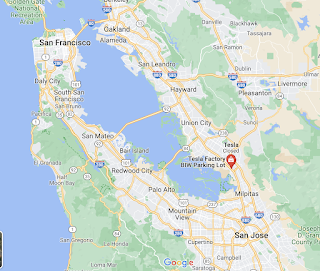
Ooohkayyy... Let me show you where this factory is located:
It's squarely in the Bay Area, which is one of the most liberal areas known to man persons. It's just down the road from Oakload, which is heavily Black. If this behavior was really happening at the scale indicated, I would fully expect mobs from Oakland to come and burn down the factory - while mobs from San Jose and San Francisco with artificially colored hair paraded cleverly-worded signs outside.

This claim is almost certainly massively exaggerated bullshit, based on a few events. I mean, the Confederate Flag? If you ever flew it here, your house and car would be burned down in short order. But, and here's the kicker, it might contain a kernel of truth.

Thing is, these "triggering events" aren't coming from the well-established white supremacists in the Bay Area (either of them). They're coming from the near-minimum wage factory worker class - and, to no-one's surprise, this is dominated by recent immigrants: Very few of whom are in any way white.

The dirty secret which the California civil rights agency skirts around is, and this goes back to Harper Lee's "To Kill a Mockingbird", practical racism mostly happens around the same strata in society. The Ewells were racist - eventually, fatally so - to Tom Robinson because he was only one rung below them in society - a hard-working black man, not far off from doing better than the wastrel crackers who formed the Ewells. Things have not changed much in 60 years.

The relevant strata of society in the case of Tesla - and any other manufacturing company in the Bay Area - is recent immigrants in manual labour, earning not much above the minimum wage. There is strenuous competition for these jobs, and indeed for the positions just above them that have more security and better prospects. As such, you tend to see the various communities form "views" on the other communities. And, unfortunate as it might be, African-Americans are seen as the least hard workers and least dependable.

From reported experience in major cities, in both USA and Canada, newly immigrated Hispanics and East Asian Americans tend to be reasonably coherent groups, with intra-group solidarity (if you were Manuel Labor on the factory floor, you'd support Javi in his attempt to get a full-time position because he's "one of you", you'd grudgingly agree that Binh from Vietnam could do the job but he's clearly trying to climb to the management ladder, but there's no way you want Marland from Jamaica because he's always complaining and making other people fix his mistakes, but the boss won't fire him because he's black and they can't be doing with the inevitable racial discrimination claim...

This is deliberately a caricature, but it's the practical reality in a wide range of jobs around here. There's strenuous competition for jobs and advancement, so the natural defensive tendency of the human is to join a tribal group for self-protection, and absorb their attitude towards other groups.

Interestingly you don't get so many (proportionate to immigration rates) South Asians in these jobs - they tend to come to the Bay Area on graduate-level visas, or head towards their own small business rather than working for The Man. But still, they have a view on Black Americans, and it's often informed by the relative racial proportion of people robbing their - and their extended family's - retail establishments.

I particularly liked this claim from the article:

One was lodged by a female Black employee who said her female white boss struck her with a hot grinding tool and called her “stupid” and the N-word and insulted her intelligence. The suit says the supervisor was fired but later rehired.
A white woman, in the Bay Area, using physical violence and calling a Black woman the N-word in earshot of anyone else? And the company re-hires her? I would love to hear the details of this case. I suspect the actual facts are quite different to the stated ones.

I understand that the California governing class is mad at Elon for taking his money away from them, and that an accusation of racial discrimination is the easiest tool to exact revenge. But let's not be fooled - these claims are likely 90% bullshit, and the core of real racism arises from the struggle for good jobs and money between non-white ethnic groups.

2021-09-20

The Mythical Bay Area Mask Mandate

I had to buy a pair of shoes today, and so decided to use the mall visit to test the effect of the "mask mandate" that theoretically grips San Jose in its iron fist.

My selected target was an anonymous, generic, medium-quality indoor mall. I approached it in regular clothing, with no mask or other face covering in sight - I had a mask in my back pocket should things prove sticky at any point. Spoiler: they didn't.

Within the body of the mall, I passed by security guards at least four times in close proximity. No-one said anything. I was careful not to lock eyes in challenge, just looked ahead at a destination store and occasionally consult my phone.

Of the other stores:

  • I avoided CVS (Pharmacy), and the pharmacy area of Target - didn't want to unnecessarily disturb sick people
  • Within Target there was no reaction, even though I walked past several staff members.
  • Discount clothing store #1 - nada
  • Footwear store #1 - very relaxed, even when I asked them questions
  • Discount clothing store #2 - no challenge, but a staff member was wearing trousers well below his underwear waistline so I'm not surprised he didn't say anything. Let he who is without sin, et cetera...
  • Discount clothing store #3 - v helpful, no comment on lack of mask.
  • Footwear store #2 - no problem at all, friendly even through the purchase of shoes.

Summary: no-one gives a shit on enforcement of the mask mandate. It's way too much hassle. Don't feel constrained to wear a mask. That said, everyone else in the mall I saw was wearing one, even though some were way below the nose and only being worn for the form of things.

Also note: as a highly white person with clear diction, if there were anyone expected by shop staff to be a nark, and therefore demand mask-compliant behavior, it would be me.

I'm rather disappointed that I didn't have to pull out my explanation:

"I'm feeling the spirit" -SF Mayor London Breed, explaining why she was dancing without a mask in one of her city's nightclubs , contrary to her own order

2021-04-18

Lemon Socialism - California style

What would happen if the Communists occupied the Sahara?
Answer: Nothing—for 50 years. Then there would be a shortage of sand
There's a significant squeeze (pun totally intended) on California citrus fruits recently. Per the Produce Blue Book:
Throughout the analyzed period, lemon prices for product coming from South & Central California, have been increasing which is in contrast with to stable pricing of the 2019 season, said Miguel Montero, executive vice president of strategy and revenue with Agtools Inc.
Anecdotally, I can confirm. Supermarket lemon and lime prices in particular are significantly up compared to last year.

OK, so what? Pandemic drives increased demand, there's inelastic supply, prices rise.

Problem is, supply is very elastic. In California, fruits are weeds. When you move to California from Wisconsin, Maine or wherever, if you have a garden of any size then you'll have citrus trees: orange, lemon, grapefruit; also non-citrus pomegranate, apricot, asian pear, Japanese plum, persimmons. Even bitter orange, if you like a mouth-wrenching sour taste and vicious thorns.

It's not like this has been a citrus-hostile recent climate. The neighbourhood orange and lemon trees are very fruitful this year. They grow everywhere, and without any particular gardening care other than a bit of water now and again.

You'd expect that anyone with a reasonable-sized garden would be able to sell their lemons and oranges into the local market to take advantage of rising prices. You'd be wrong. Doing this is limited to road-side stalls outside the main Bay Area, where local law enforcement knows not to ask too many questions. Try this in San Jose and you'll be hit with citations for missing permits, causing a nuisance, and various public health violations.

Law enforcement carries out public policy. Public policy is to keep prices high for local major farmers, and allow indocumentados to earn a living without too many questions. Anyone else with citrus trees is shit-outta-luck.

2021-04-10

Unionizing Amazon

Today Amazon managed to defeat a unionization effort at their Bessemer, Alabama warehouse, by a margin of 2 to 1. This has not gone down well with the pro-union folks:

Why are they so upset? Ah, pull up a chair and let's review the recent (and not so recent) history of unionization drives in tech.

Amazon

You can't talk about Amazon without also talking about The Dread Pirate Bezos. Jeff Bezos is an unmitigated genius, but also not one to tolerate threats to his businesses. Any attempt at unionization of the workforce - yielding a significant amount of control from Bezos to union leads - is going to get shut down pretty damn quick.

Parenthetically, my favorite Bezos story came from ex-Amazon engineer Steve Yegge in a rant about the way that Amazon really got platforms (and Google didn't):

His [Bezos] Big Mandate went something along these lines:

1. All teams will henceforth expose their data and functionality through service interfaces.
[...various tech points elided...]
6. Anyone who doesn't do this will be fired.
7. Thank you; have a nice day!

Ha, ha! You 150-odd ex-Amazon folks here will of course realize immediately that #7 was a little joke I threw in, because Bezos most definitely does not give a shit about your day.
#6, however, was quite real, so people went to work.
Had Bessemer actually voted to unionize, I could well imagine Bezos closing down the facility in the not-too-distant future - I'm sure he'd have offered plausible reasons, but the real message would be to other Amazon workplaces. "We're quite happy to lose money in the short term to avoid having unions directing our business. Are you happy to lose your jobs?"

But why does Jeff care so much about unionization?

Intel

In the fascinating 1998 book "Inside Intel" there was a great case study of how a major tech company reacts to a unionization effort. If memory serves, this was in a chip fabrication plant ("fab") with hourly-paid workers - might have been in Oregon, I don't recall - and it was a push by a national union to get the local workforce unionized. The plant manager realized this was a big issue, contacted Intel senior management, and they pitched in a bunch of people and resources to counter the unionization campaign. The management's key objective was: "we need to do everything we can to prevent the plant unionizing, but we can't let them know how much we care about it. The vote was in Intel's favor, and the union moved on.

So why did Intel management care so much about unionization?

Google/Alphabet

Last year the Alphabet Workers' Union spun up, which now has 800+ members across Google and the other companies in Alphabet (the parent firm). At the moment it's purely voluntary membership and doesn't - as far as I can tell - have any official status in work conditions/pay negotiation.

A clue to their motivations comes from their home page:

Our union of 800+ members strives to protect Alphabet workers, our global society, and our world. We promote solidarity, democracy, and social and economic justice.
This might hint at why Google/Alphabet is so wary of unionization.

Apple

Apple has maintained a very solid anti-union front. The one case I could find is where their shuttle bus drivers successfully unionized - no other instances I could locate had unions appearing at Apple stores or corporate workplaces.

So what does Tim Cook have against unionization?

Why does Big Tech hate unions?

It's quite simple at one level. The effect of unionization of your workforce is that you give up some amount of control, and bear some level of increased costs and lower efficiency. If you've got a large workforce of low-to-medium wage semi-skilled workers - e.g. Amazon warehouse staff, Intel fab plant staff - and you're constantly honing processes to improve your margin, the last thing you want is a union-imposed drag on your bang-per-buck.

The more interesting question comes when you're looking at a skilled, expensive workforce. Unionization isn't going to materially affect your wage bill for a highly technical workforce in an active competitive recruitment market. However, it will prove a distraction, and possibly a major one, because the union wants to tap into your workforce's salary - 1% union dues on an average wage of $100K turns out to be quite a lot of money for a 5,000-person company, let alone a 50,000 person company - and to justify this, they need to show that they're doing something.

So inevitably the union is going to be dragging your company's managerial layers into prolonged wage and conditions negotiations, pursuing pet causes, trying to eject people that they regard as "undesirable" - e.g. anti-union, pro-business - while trying to retain people that management regards as "undesirable" - e.g. ineffective, spending too much time on pet causes. They're going to seek "equity" of salaries - looking for differentials by gender, race and age and poking at anomalies. Their executive is looking for a steady income stream and an increasing amount of power, and they're not going to take "no" for an answer.

The unionization struggle, I think, is going to be over approximately 1-2 years after a union gains a significant foothold in a major tech company. The highly productive people are going to see the brake on company productivity in general, and their salaries in particular, and go looking for employment somewhere they don't have to carry as many passengers. In the mean time, the company is going to burn.

If you don't believe me, look at the car manufacturers in Detroit.

2021-02-28

COVID protection insanity - Sarah Cody

Santa Clara County, which is mostly the megapolis of San Jose, is making its COVID policy through its County Health Officer Dr Sarah Cody, and if there ever was an example of the Peter Principle - Petra Principle? - then she is it.

Witness Friday's announcement about loosening restrictions in Santa Clara:

Santa Clara County loosened some guidelines Friday while keeping others tightly in place. It now says if you're six feet apart, and outdoors, masks are no longer required.
According to Twitter, up until now, many residents of Santa Clara had no idea that they had to wear masks while outdoors and 6+ feet away from anyone else. This is not surprising because it is completely insane. Technically, if you were jogging on a public trail last Thursday with no-one within 100 yards, you were violating these restrictions. There is no evidence that COVID spreads outdoors between people 6ft+ apart - none! Yet Cody found it necessary to impose the restrictions nevertheless.

I've played the ball (the restrictions) so now I feel justified in playing the man (Cody).

Cody was appointed in 2013, succeeding her boss - she had spent the past 15 years working as a Deputy Health Officer at the Santa Clara County Public Health Department. If I saw that promotion profile on a resumé I'd have absolutely no confidence that the promotion was earned. It was either for convenience - the leadership didn't really bother advertising and interviewing - or diversity, where she was the only female candidate. The latter seems a bit unlikely because public health officials tend to be female, so I'm leaning towards "convenience". Definitely not "competence".

Cody has comprehensively screwed up Santa Clara's response to COVID, mounting increasing strict restrictions which have had no differential impact on the spread and effect of the virus compared to elsewhere. She invents random priorities for vaccination just to show that she's involved and hip to minorities - rather than taking hard-won experience from other countries and implementing as-is. She is astonishingly out of her depth. I'm sure she's a competent middle-of-the-road medic, but she apparently has no idea how to consider the business and other aspects of her random pronouncements.

I would like to see every restaurant in San Jose, having suffered 3 months of shut-down indoor dining and 2 months of any dining at all despite their investments in outside facilities, post a picture of Sarah Cody - and her minions - in their front windows. Text underneath: "BANNED: not to be served at this establishment". Hope she likes McDonald's and KFC.

That said, Cody doesn't get the full blame; when the local population is full of neurotics, pandering to them is very tempting.

"It feels good, but at the same time it's nerve-wracking not wearing it, see, that's why I still have it on, you never know, boom, here we go,” said Monica Hernandez of Cupertino.
Monica Hernandez should shut herself in a closet in her apartment if she's that afraid. Let the rest of us try to restart the economy that Dr Sarah Cody has throttled to death.

2020-06-28

Surviving Diversity Training

If you work in a bureaucratic or enterprise organisation, the inevitable result of 2020’s bout of intellectual masturbation on the topic of Black Lives Mattering is going to be more "training" based on the apparent need to increase diversity in your organisation at all costs. One is reminded of the remarks of the great American satirist Tom Lehrer in the intro to his song "It Makes a Fellow Proud to be a Soldier”:

“...one of the many fine things one has to admit is the way that the Army has carried the American democratic ideal to its logical conclusion, in the sense that not only do they prohibit discrimination on the grounds of race, creed and color, but also on the grounds of ability.”
How then can we unenlightened peons “ride the wave” of diversity training so as to achieve the maximum benefit? Allow your humble correspondent to guide you.

Assuming that you're taking an in-person or video-driven interactive training session, the first thing to understand are your own objectives:

  • Are you hoping to benefit from what’s being taught;
  • Are you looking for the minimum interaction and distraction for your life; or
  • do you resent the intrusion on your life and intend to resist actively?
All are valid choices, but make sure you pick one and plan for it. Are you aiming to avoid risk of being disciplined/fired? That's also an important factor to be aware of. If you're 63 and planning to retire soon, you might well not care at all, and in fact being fired could be a trigger for a lucrative constructive dismissal suit. If you've just accepted a job at another company which is not full of woke scolds, you can probably go to town. If you're 22 and just starting your career, your risk appetite is likely very small. Know before you go.

You also need to understand your “facilitator” (session leader), what they’re trying to achieve, and how they’re intending to do it. Unless they’ve just come down with the last shower, they will be mentally grouping their audience as above, and labelling each of you "learner", "holidaymaker" or "prisoner" - who says that stereotyping doesn't serve a purpose? Generally they try to focus on the first group and minimize contact with the others, but you might come across someone who is on an evangelical mission to convert everyone - in that case, holidaymakers and prisoners are no longer safe.

Course pre-reading and objectives

A tactic I've recently seen is to distribute “pre-reading” around the group. To make sure it gets done, they may also require everyone to prepare a small amount of pre-work based on the reading. This might be a form you have to submit before the course, or to assemble some written notes on your response to it, or to prepare a scenario for discussion in the group. (e.g. to answer: “what is a time that you felt uncomfortable in a racially charged situation? How did you respond? How did you think the other parties felt?”)

If your corporate training department is doing its job - and it’s quite possible that they aren't - the course description should come with some stated learning objectives. This will tell you a lot about what the course is trying to get you to do, and it will also clue you in to what evidence they might expect the course to produce. After all, the instructor can’t blithely claim "everyone is racism free now, that will be $5000 please!", or at least they shouldn't be able to. Therefore your company will be expecting objectives that are at least somewhat measurable, and expect to measure them.

The objectives will therefore tell you what the instructor wants you to be thinking or to have achieved by the end of the class, giving you a clear signpost to the topics under discussion. This can be a useful prompt to do pre-reading around the topics. For instance, if it requires "understanding the causes and result of implicit bias" then understanding the original study and the various debunkings can prepare you well for raising pointed questions.

Conducting yourself in session

If you intend to be a holiday maker, the worst thing to do is to make this apparent in the first ten minutes of class. Turn up a bit early, be chatty with the facilitator and others, take active part in the icebreaker activity (there's almost always an icebreaker). That should buy you some initial credit with the instructor, even though you disengage for the rest of the session. I'd also recommend doing the same burst of activity when you come back from each break. That way the instructor starts to get the impression that he or she is boring you, despite your best efforts to be attentive. Or possibly that you're snorting cocaine in the bathroom in the breaks, which I cannot endorse.

If you're a "prisoner" looking to tunnel out, I'd actually recommend a similar approach. At the very least, you don't want to look hostile in the first ten minutes. (And you shouldn't be hostile then anyway, because even the most painfully right-on diversity trainer deserves a chance to show that they're trying to make this session useful and interesting.) However, it's fine to develop a more quizzical look and increasingly more defensive body language over time. Evolve from an occasional raised eyebrow to stroking/holding your chin (showing disagreement with what the facilitator is saying), to crossed arms, to switching between crossed arms and crossed legs, depending on how obvious you want disagreement to be. This raises an implicit challenge to the facilitator, and whether they take you up on it can indicate their level of confidence in their content.

These events are normally "laptops down, phones down" so that everyone is "present". However taking a notebook and pen won't raise any eyebrows, and these can be useful tools. Whenever the facilitator says something weird or objectionable, you can take a direct note. This can be great material for feedback (see later). At worst, you can draft a love letter to your garage mechanic - no-one's going to ask to see your notes, and if they do then you can indignantly refuse. Make sure it's your own pen and own notebook.

Video sessions come with their own opportunities and challenges. For holidaymakers, feigning attention on video is a whole topic in itself, but you want to watch out for the facilitator calling on you for a response when you have no idea what they just said. Normally they require everyone to have video on and be on mute by default, which buys you a few seconds to "fumble" for un-mute. I recommend using an external, wired mike (e.g. on headphones), and so if you're stuck then gently move the plug out and in while you're talking to fake a dodgy connection. Practice makes perfect! Remember to temporarily stop using that mike and move to just using the laptop mike - it's then fine to "reset" your machine at the next break and report things "working" again.

I also recommend setting up poor lighting conditions in your room; either a strong light source causing glare (sun through a window), or curtains drawn to "remove the glare" but leaving a dark, grainy picture. Touching an unwashed thumb on the camera lens can help too - be sure to clean it after the session! For dark rooms, remember that glasses can reflect the colours of your screen so check before the meeting to see if they give anything away.

Group and pair exercises

Ideally, have a good friend in the same session who has similar views on these mandatory training events, and pair off with them for exercises if you get the chance. However, experienced facilitators will make people rotate round groups, so you've got to plan on group exercises with one or more "committed" learners. In my experience the best way to handle this is to realise that people love to talk about themselves - and the self-righteous adore it. So lead them into talking about their experiences, ask "concerned" and "interested" open questions such as "how did that change how you thought about...", and let them run out the clock for you.

You're going to need to have one or two experiences to talk about, if you don't have an obvious topic then I recommend something like:

  • the time you were the only white person / male / non-tranvestite in a place and had an epiphany "this must be what it's like to be black / female / a cross dresser all the time!"; or
  • childhood experience being once-off mean to someone black / female / cross-dressing which you only ten years later realising how that affected their relationships in school and oppressed them; or
  • if you're got military experience, something on perception of veterans - veteran status is protected in the USA, and companies often have diversity outreach efforts focused on veteran hiring not least because they work hard and are good at execution and leadership but strangely diversity courses seldom talk much about this.

Stirring the pot

If you've got a best friend / partner / family member in a "protected" category, and frowns on "diversity" training, don't be afraid to cite them. "My mate is black and he says it's daft to focus on deaths caused by police as long as we're all shooting each other all the time" - as long as he'll back you up on that, you can probably get away with it. It will derail the hell out of the conversation, so make sure you're comfortable with raised emotions if you're going to try this.

The Equity, Diversity and Inclusion (EDI) label is itself ripe for manipulation. You could refer to it as Diversity, Inclusion and Equity (DIE); or perhaps Inclusion, Equity and Diversion (IED), making sure to use the appropriate abbreviation. Every firm should have a constructive IED program, after all!

Agreeing with "Black Lives Matter" and raising the game by suggesting "Unborn black lives matter too!" addressing the 35% abortion percentage in the black community is probably only viable if you don't mind a meeting-without-coffee with your boss and HR afterwards. Mind you, if you're a well-established Christian (or Muslim!) you might be able to get away with it.

If they do mention deaths-at-the-hand-of-police, you can refer to my previous analysis of the 2015 black unarmed fatalities in the USA. Short version: if you're not armed, and don't actively try to attack a police officer, you're actually remarkably safe even if you're black.

Raising the well-documented differences between genders is only for the suicidally determined. The facts might be with you, but you can expect prompt personal attacks on you during and after the course.

Constructive feedback

There is almost inevitably a post-course survey. The temptation is to blow this off with the minimum of effort, but If you actually want to effect changes then this is one of the best bang-for-your-buck places to make effort.

In terms of scoring, try not to be too much of an outlier. Score the content and the facilitator honestly and separately if you can. You can have the world's best facilitator, but if they're stuck with bad or dishonest material then there's only so much they can do. Highlight how the course has failed to help you meet the objectives or failed to be convinced about the assertions.

Where possible, make recommendations for "improving" the exercises. Say that there needs to be more time / quicker switching around / better briefing / more guidance on picking the right focus topic / content that you can better relate to. Again, you want to show helpfulness so they don't dismiss your scores and feedback as "grumpy prisoner".

If the facilitator or someone in the class has said something actually offensive, don't hold back from flagging it - I'd suggest without naming the person, at least initially. Make sure you wrote it down verbatim at the time in your notes, with the point in the session marked, so you can point to your notes as evidence.

Next steps

With luck, that will be it for the next year or so. No matter how woke the company, diversity training is expensive in terms of lost productivity, so they're unlike to repeat it unless they feel they have to. Sit back and enjoy 364 days of just treating people like people without fear or favour no matter what their skin colour, gender, age, or religion.

2020-05-10

Harmeet Dhillon picked a winner

I enjoyed reading a Gizmodo article today. (This is not a common occurrence). The article itself was a mostly-triumphant comment on James "neurotic women" Damore closing his lawsuit against The Google:

Damore proceeded to sue Google for discrimination in January 2018. Per Bloomberg, three other men who worked for or applied for jobs at Alphabet, Google’s parent company, also signed on to Damore's lawsuit. In the lawsuit, Damore's lawyers argued that he and others "were ostracized, belittled, and punished for their heterodox political views, and for the added sin of their birth circumstances of being Caucasians and/or males."
I read the internal blog posts in the initial complaint, and to be honest it looked pretty problematic for Google. So why close the lawsuit now?

Aha! a clue in a the Bloomberg article on the suit conclusion:

A lawyer for the men, Harmeet Dhillon, said they're prohibited as part of their agreement with Google from saying anything beyond what's in Thursday’s court filing. Google declined to comment.
It's pretty clear, isn't it? Google settled. They looked at what would plausibly come out of discovery, and - even if they were pretty confident in a Silicon Valley jury taking the socially woke side of the case - didn't like how a court case would play out in public. This is a guess on my part, to be clear, but a fairly confident guess. How much would a company pay for positive nationwide publicity? You can treble that for them to avoid negative nationwide publicity.

Damore probably got fairly close to a sensible loss-of-earnings amount. Harmeet Dhillon, his lawyer probably got 30%-40% of that; maybe on the lower end because the publicity was worth beaucoup $$ to her.

When your ess-jay-double-yuh's
Cost you many dollars,
That's Damore!

When their memes and blog post
Enrich lawyers the most
That's Damore!

2020-03-07

Women in charge equals... piss-poor arguments

I'd like to draw attention to an inspiring call to action[1] from NZ's minister for women, Julie Anne Genter:

On International Women’s Day, let’s commit to properly compensating women for the unpaid and underpaid work they have always done
A wonderful sentiment! Let's analyse the arguments she presents. Oh wait, it's the Guardian - we're limited to analysing randomised woke bloviating, but let's try to treat it as a principled argument.

What's the top wrongness that we're trying to right?

The world would stop running were it not for the unpaid and underpaid work undertaken by women.
Also true for men. What's your point?
It is tempting to think that women being paid fairly is down to individual choices each person makes. That women just need to apply for different jobs, negotiate for higher salaries, or put themselves forward more.
Yes, indeed. For some reason, trash-collection jobs (early morning, physical exertion, people getting irate if not done properly) are paid higher than hiring diversity managers (10am-4pm flexible hours, hard to measure output, no-one really cares if you turn up to work). It's a shocker.
But that ignores some of the fundamental reasons the gender pay gap remains so stubbornly high.
Oh, do tell.

Julie now switches to blatant sexism:

Female-dominated occupations such as nursing, teaching and caring are indispensable around the world. We must recognise and value their skills and contribution.
You're arguing that male nurses and elementry teachers - who are (obviously) fighting against stereotypes to join their professions - are volunteering to take lower-paid roles than they could otherwise have got? Or are you arguing that they are on average so incompetent that this is their best available gig? Please clarify.

She concludes with an inspiring call to action:

Today, on International Women’s Day, I want more countries to follow our lead and do more to see all women paid fairly. We can end the gender pay gap in our lifetime.
Absolutely. Just make illegal discrimination by gender for hiring in any given job role. Then women can apply for any job they want and be treated exactly the same as men. Great idea.

Already enshrined in law, apparently? Job done then, Julie. Time to resign and save the NZ taxpayer the cost of your salary.

[1] No, not really. But I guess you knew that.

PS: shockingly, Julie Ann Genter is a UC Berkeley philosophy graduate. Bet you couldn't have guessed that from her writing. And she's a member of the New Zealand Green Party, laying claim to a legacy of intellectual rigor that stretches back to... who am I kidding.

2019-09-27

The pace of PACER

Permit me a brief, hilarious diversion into the world of US Government corporate IT. PACER is a USA federal online system - "Public Access to Court Electronic Records" which lets people and companies access transcribed records from the US courts. One of their judges has been testifying to the House Judiciary Committee’s Subcommittee on Courts, IP, and the internet and in the process revealed interesting - and horrifying - numbers.

TL;DR -

  1. it costs at least 4x what it reasonably should; but
  2. any cost savings will be eaten up by increased lawyer usage; nevertheless,
  3. rampant capitalism might be at least a partial improvement; so
  4. the government could upload the PACER docs to the cloud, employ a team of 5-10 to manage the service in the cloud, and save beaucoup $$.
Of course, I could be wrong on point 2, but I bet I'm not.

Background

PACER operates with all the ruthless efficiency we have come to expect from the federal government.[1] It's not free; anyone can register for it, usage requires a payment instrument (credit card) but it is free if you use less than $15 per quarter. The basis of charging is:

All registered agencies or individuals are charged a user fee of $0.10 per page. This charge applies to the number of pages that results from any search, including a search that yields no matches (one page for no matches). You will be billed quarterly.
You would think that, at worst, it would be cost-neutral. One page of black+white text at reasonably high resolution is a bit less than 1MB, and (for an ISP) that costs less than 1c to serve on the network. Therefore you spend less than 9c on the machines and people required to store and serve the data, and profit!

Apparently not...

The PACER claims

It was at this point in the article that I fell off my chair:

Fleissig said preliminary figures show that court filing fees would go up by about $750 per case to “produce revenue equal to the judiciary’s average annual collections under the current public access framework.” That could, for example, drive up the current district court civil filing fee from $350 to $1,100, she said.
What the actual expletive? This implies that:
  1. the average filing requests 7500 pages of PACER documents - and that the lawyers aren't caching pages to reduce client costs (hollow laughter); or
  2. the average filing requests 25 PACER searches; or
  3. the average client is somewhere on the continuum between these points.
It seems ridiculously expensive. One can only conclude, reluctantly, that lawyers are not trying to drive down costs for their clients; I know, it's very hard to credit. [2]

And this assumes that 10c/page and $30/search is the actual cost to PACER - let us dig into this.

The operational costs

Apparently PACER costs the government $100M/year to operate:

“Our case management and public access systems can never be free because they require over $100 million per year just to operate,” [Judge Audrey] Fleissig said [in testimony for the House Judiciary Committee’s Subcommittee on Courts, IP, and the internet]. “That money must come from somewhere.”
Judge Fleissig is correct in the broad sense - but hang on, $100M in costs to run this thing? How much traffic does it get?

The serving costs

Let's look at the serving requirements:

PACER, which processed more than 500 million requests for case information last fiscal year
Gosh, that's a lot. What's that per second? 3600 seconds/hour x 24 hours/day x 365 days/year is 32 million seconds/year, so Judge Fleissig is talking about... 16 queries per second. Assume that's one query per page. That's laughably small.

Assume that peak traffic is 10x that, and you can serve comfortably 4 x 1MB pages per second on a 100Mbit network connection from a single machine; that's 40 machines with associated hardware, say amortized cost of $2,000/year per machine - implies order of $100K/year on hardware, to ensure a great user experience 24 hours per day 365 days per year. Compared to $100M/year budget, that's noise. And you can save 50% just by halving the number of machines and rejecting excess traffic at peak times.

The ingestion and storage costs

Perhaps the case ingestion is intrinsically expensive, with PACER having to handle non-standard formats? Nope:

The Judiciary is planning to change the technical standard for filing documents in the Case Management and Electronic Case Filing (CM/ECF) system from PDF to PDF/A. This change will improve the archiving and preservation of case-related documents.
So PACER ingests PDFs from courts - plus, I assume, some metadata - and serves PDFs to users.

How much data does PACER ingest and hold? This is a great Fermi question; here's a good worked example of answer, with some data.

There's a useful Ars Technica article on Aaron Swartz that gives us data on the document corpus as of 2013:

PACER has more than 500 million documents
Assume it's doubled as of 2019, that's 1 billion documents. Assume 1MB/page, 10 pages/doc, that's 10^9 docs x 10 MB per doc = 10^10 MB = 1x10^4 TB. That's 1000 x 10TB hard drives. Assume $300/drive, and drives last 3 years, and you need twice the number of drives to give redundancy, that's $200 per 10TB per year in storage costs, or $200K for 10,000 TB. Still, noise compared to $100M/year budget. But the operational costs of managing that storage can be high - which is why Cloud services like Amazon Web Services, Azure and Google Cloud have done a lot of work to offer managed services in this area.

Amazon, for instance, charges $0.023 per GB per month for storage (on one price model) - for 10^9 x 1MB docs, that's 1,000,000 GB x $0.023 or $23K/month, $276K/year. Still way less than 1% of the $100M/year budget.

Incidentally Aaron Swartz agrees with the general thrust of my article:

Yet PACER fee collections appear to have dramatically outstripped the cost of running the PACER system. PACER users paid about $120 million in 2012, thanks in part to a 25 percent fee hike announced in 2011. But Schultze says the judiciary's own figures show running PACER only costs around $20 million.
A rise in costs of 5x in 6 years? That's approximately doubling every 2 years. As noted above, it seems unlikely to be due to serving costs - even though volumes have risen, serving and storage costs have got cheaper. Bet it's down to personnel costs. I'd love to see the accounts break-down. How many people are they employing, and what are those people doing?

The indexing costs - or lack thereof

Indexing words and then searching a large corpus of text is notoriously expensive - that's what my 10c per electronic page is paying for, right? Apparently not:

There is a fee for retrieving and distributing case information for you: $30 for the search, plus $0.10 per page per document delivered electronically, up to 5 documents (30 page cap applies).
It appears that PACER is primarily constructed to deliver responses to "show me the records of case XXXYYY" or "show me all cases from court ZZZ", not "show me all cases that mention 'Britney Spears'." That's a perfectly valid decision but makes it rather hard to justify the operating costs.

Security considerations

Oh, please. These docs are open to anyone who has an account. The only thing PACER should be worried about is someone in Bangalore or Shanghai scraping the corpus, or the top N% of cases, and serving that content for much less cost. Indeed, that's why they got upset at Aaron Swartz. Honestly, though, the bulk of their users - law firms - are very price-insensitive. Indeed, they quite possibly charge their clients 125% or more of their PACER costs, so if PACER doubled costs overnight they'd celebrate.

I hope I'm wrong. I'm afraid I'm not.

Public serving alternatives

I don't know how much Bing costs to operate, but I'd bet a) that its document corpus is bigger than PACER, b) that its operating costs are comparable, c) that its indexing is better than PACER, d) that its search is better than PACER, e) that its page serving latency is better than PACER... you get the picture.

Really though, if I were looking for a system to replace this, I'd build off an off-the-shelf solution to translate inbound PDFs to indexed text - something like OpenText - and run a small serving stack on top. That reduces the regular serving cost, since pages are a few KB of text rather than 1MB of PDF, and lets me get rid of all the current people costs associated with the customized search and indexing work on the current corpus.

PACER is a terrible use of government money

Undoubtedly it's not the worst[3], but I'd love for the House Judiciary Committee’s Subcommittee on Courts, IP, and the internet to drag Jeff Bezos in to testify and ask him to quote a ballpark number for serving PACER off Amazon Web Services, with guaranteed 100% profit margin.

Bet it's less than 1/4 of the current $100M/year.

[1] Yes, irony
[2] Why does New Jersey have the most toxic waste dumps and California the most lawyers? California New Jersey got first choice. [Thanks Mr Worstall!]
[3] Which is terribly depressing.

2019-07-26

Scentrics is still worth half a billion quid, and other fiction

Suppose that you were a UK company with a real valuation of £500M. Would you - or indeed, your shareholders - tolerate you teetering on the edge of being de-listed as a UK company?

If your company name is Scentrics, it appears that you would:

Date: 04/06/2019
Ref: DEF6/06539484

Companies Act 2006 (Section 1000(3))

The Registrar of Companies gives notice that, unless cause is shown to the contrary, at the expiration of 2 months from the above date the name of
SCENTRICS INFORMATION SECURITY TECHNOLOGIES LIMITED
will be struck off the register and the company will be dissolved

Apparently Scentrics, as a nominal £500M valuation company, finds it too expensive to employ a £20K/year admin to ensure that their basic legal obligations to their national legal authority are covered.

But they are totally still worth half a billion quid, if you're a prospective investor. Swear it, cross my heart.

Scentrics did actually fix the problem - at least, for now:

Date: 06/07/2019

Cause has been shown why the above company should not be struck off the register and accordingly the Registrar is taking no further action under section 1000 of the Companies Act 2006 pursuant to the Notice dated 03/07/2019
Presumably, the previous notice scared the cr*p out of the Scentrics directors and got them to scramble to address the cause of the proposed strike-off. I'd give a good few quid to know that cause, by the way.

The Scentrics accounts for year end June 2018 still assert that Scentrics is worth a bit short of half a billion quid, but the directors certainly aren't acting like this is actually true; per the doctrine of revealed preference, one is left with the conclusion that those owning the shares believe that it's worth, on the balance of probabilities, only a small multiple of the employment costs of a part-time admin assistant with UK company law knowledge.

Sure, it's totally worth £500M. Practically all of its assets are intangible, it has £90M of liabilities, and no-one has taken a good hard look at its accounts. I have £100 that says it will not have more than £10K of tangible assets in 5 years time. Anyone like to take the other side of that bet?

2018-12-08

Life of an actuary: more exciting than you might believe

When I was in university and hanging around the mathematicians - those students who dedicated their life to math(s), and I use "life" in the loosest sense possible - the standard joke was that the really successful ones would get involved in professional gambling[1], most of them would be accountants, and the ones who couldn't handle the excitement of accountancy[2] would become actuaries.

At least two of the three were true. Approximately the majority of the mathematicians I knew ended up in accountancy or related consultancy, and the actuaries were definitely around the low end of the social scale in the subject. Given the starting point of a mathematics degree, that's a scale needing very fine calibration. Anyone who chose optional courses in computer science ended up working for Big Tech and making out like a bandit.

Today I stumbled across a site Be An Actuary, which is (as far as I can tell) not a spoof site. It contains invaluable advice and guidance on what to do if you feel that actuarialism[3] is your calling, and a critical piece of information is what a day in the life of an actuary is like.

Before reading these quotes, you may wish to equip yourself with a spoon[4].

So far today, I've researched the applicable accounting rules and written a report for a client who's acquiring a small life insurance company.
Be still my beating heart.
I am constantly asking myself "Does this make sense?".
I'm assuming that "this" doesn't apply to "my terrible career choice". But it should.
In a midsize company like mine, there is also opportunity to price a new product, which takes creativity, or respond to an insurance department inquiry, which requires communication skills and tact.
Or, in despair at my life, throw myself through a 10th floor window, which requires a good run-up.
I currently manage three reserving analysts and we spend most of our time doing reserve analyses and projects like catastrophe modeling, loss modeling for some of our low frequency/high severity lines, and supporting our Corporate Actuary as he writes Actuarial Opinions and Reports.
You should spend some time on serious introspection on how your life got to be this way.[5]

If you still have more than one eye remaining to view the remainder of this blog post, you're a more resilient person than me.

[1] Specifically, running the numbers games in the casinos rather than playing them.
[2] Yes, that's irony.
[3] Probably not a word, at least I hope not.
[4] Because it's DULL, you twit. It'll hurt more.
[5] Probably, you have Korean/Indian/Chinese parents and you paid more attention to their ambitions than your desires.

2018-11-02

Unionism in Silicon Valley - called it

Back in January I made the following prediction:

What do I think? Twitter, Facebook and Google offices in the USA are going to be hit with unionization efforts in the next 12 months, initially as a trial in the most favorable locations but if they succeed then this will be ramped up quickly nationwide. This will be framed as a push to align the companies to approved socially just policies - which their boards mostly favor already - but will be used to leapfrog the activist employees into union-endorsed and -funded positions of influence.

Sure enough, a bunch of Google staff walked out of work today, nominally to protest at ex-Android head Andy Rubin getting a cool $90M in severance after being accused of dubious behaviour with someone in a hotel room, which he denies:

Rubin said in a two-part tweet: “The New York Times story contains numerous inaccuracies about my employment at Google and wild exaggerations about my compensation. Specifically, I never coerced a woman to have sex in a hotel room. These false allegations are part of a smear campaign to disparage me during a divorce and custody battle. Also, I am deeply troubled that anonymous Google executives are commenting about my personnel file and misrepresenting the facts.”
For the record, Rubin sounds a bit sleazy even if you apply a high degree of scepticism to the exact circumstances of the event.

Let's look at the "official" walkout Twitter account, and wonder who's actually driving this organisation:

For posterity, the "demands" are:
  1. An end to Forced Arbitration in cases of harassment and discrimination for all current and future employees.
  2. A commitment to end pay and opportunity inequity.
  3. A publicly disclosed sexual harassment transparency report.
  4. A clear, uniform, globally inclusive process for reporting sexual misconduct safely and anonymously.
  5. Elevate the Chief Diversity Officer to answer directly to the CEO and make recommendations directly to the Board of Directors. Appoint an Employee Rep to the Board.
Points 1-4 seem pretty reasonable - but what does point 5 have to do with the rest of the list? And who would this "Employee Rep" be - a unionisation activist, perchance? $10 says I'm right. This is a classic tactic: take a reasonable area of complaint and use it as a Trojan Horse to sneak in the early stages of unionisation to the company.

Google allegedly employs very smart people. If only they exercised their critical faculties half as well as their intellects, they might be asking uncomfortable questions of the protest organisers about where point 5 came from and who the organisers have in mind to take on "employee rep" duties. I guarantee you that it's not Rob Pike or Jeff Dean.

2018-09-30

Mandatory women on California boards of directors: the potholes in SB-826

In a huge strike for equality[1], California has decreed that all-male boards of directors need to go the way of the dinosaurs:

This bill, no later than the close of the 2019 calendar year, would require a domestic general corporation or foreign corporation that is a publicly held corporation, as defined, whose principal executive offices, according to the corporation’s SEC 10-K form, are located in California to have a minimum of one female, as defined, on its board of directors, as specified. No later than the close of the 2021 calendar year, the bill would increase that required minimum number to 2 female directors if the corporation has 5 directors or to 3 female directors if the corporation has 6 or more directors.
Of course, there could be no material ill effects from this policy. Otherwise, I'm sure they'd have been addressed in the California Senate, whose members are clearly much more concerned with the financial health of their state rather than virtual signaling.

Speaking of which, I have a very attractive bridge situated between San Francisco and northern California which I'd be willing to sell to any interested reader.

Did anyone notice that this implies that it requires moderate-sized boards to move to 50% female representation within three years? I'm sure that this is excellent news for moderately-well-known near-C-level (tech, pharma) females in California. If I could buy shares in this demographic, I'd be all-in. However, a more directly accessible trading strategy would be based around the aforementioned set of California-based companies with 10 or fewer board members. Please note that this is not professional trading advice, you'd be crazy to trade based on the superficial research of a random person on Twitter, etc.

  • For any such company which already exceeds the 2021 criteria, hold.
  • For any such company which doesn't currently meet the 2021 criteria but will meet it with 1 additional board hire, sell if you hold it.
  • For any such company which needs to hire 2+ females to meet the 2021 criteria, sell short based on the predication of a 2022-2023 disaster
Bringing in people to the board based on gender is unfortunately disproportionately likely - based on ease of discovery - to incorporate vocal SJW-biased women who spend the majority of their time selling the story that "women are discriminated against in tech!" Now, this may even be true - in my experience, it's not, but that's another blog post - but by hiring these women the affected boards of directors are bringing aboard people whose primary interest is the "improve female representation in tech" narrative, rather than (say) "make this company work better and be more profitable". What could possibly go wrong?

In particular, any company hiring Anita Sarkeesian, Ellen Pao, Zoe Quinn, Brianna Wu, Erica Baker or other such vociferous campaigners in the context of this act is doing the equivalent of filling five of six chambers of a revolver with live ammo, pointing it at their head, and squeezing the trigger.

On the other hand, if a company's board can persuade one of its existing male members (ooh err) to "identify as female" then I'd go long on that company based on willingness to turn SJW rules back on themselves. What is California going to say? "Oh, you're not really a woman, you're just pretending?" According to the bill:

“Female” means an individual who self-identifies her gender as a woman, without regard to the individual’s designated sex at birth.
I'd imagine that any such willing volunteer would see a sharp bump in their compensation.

Practically, this incentivizes a medium-size board of directors which has at least one woman to trim excess (male) directors in order to bring them into compliance without introducing a potentially disturbing (female) member to the board. Expect to see the distribution graph of board sizes in California to take a leftwards lurch in the next couple of years.

Now, let's consider the perspective of a woman hired to a board of directors in a California-based company after this law is passed. How many people in the company will believe she was hired for her expertise? And how long will she hold the label "diversity hire" - even if the board actually hired her for her expertise? If I were a C- or D-level female executive in California, I'd be spitting mad about this devaluation of my expertise. But then, I'd bet that the lobbying for this bill came from the achievement-challenged section of the prospective candidates. "Damn my dubious merits, hire me because I'm kinda-female and very woke!"

[1] For non-British readers, this is irony. There may be more instances of this phenomenon throughout this blogpost.

2018-09-06

Scentrics worth half a billion quid - and other fiction

Regular readers (both of you) will recall my previous scepticism regarding IT "security" company Scentrics. TL;DR - they're pushing the idea that a key part of "secure" email is sending a copy of every email to a central server, encrypted with a key that only gives access to a trusted party - your local government, for instance. Singapore seemed very interested in their proposals, for reasons one can imagine.

Out of idle curiosity, I thought I'd check the Scentrics accounts for 2016-2017. Well, gosh.

 30 June 2017
£
30 June 2016
£
Fixed assets  
Intangible assets504,014,09220,455
Property, plant and equipment6,4638,618
Investments10-
 504,020,56529,073
Current assets  
Debtors1,051,5561,047,027
Cash at bank893,8152,793,822
 1,945,3713,840,849
Creditors within 1 year(893,718)(893,232)
Net current assets1,051,6532,947,617
Total assets less current liabilities505,072,2182,976,690
Provision for liabilities(99,546,235) 
Net assets405,525,9832,976,690
Capital and reserves  
Called up share capital130130
Share premium5,778,5965,778,596
Retained earnings399,747,257(2,802,036)
 405,525,9832,976,690

How would I read this? They spent £1.9M of their cash on various things during the year; about half of that on medium-to-long term debt servicing, and the rest presumably on overheads (salary, office, patent office fees, other professional service fees). This is clearly not sustainable, and indeed last year they had a net worth (retained earnings) of minus 2.8 million pounds. How could this be fixed?

Well, they've just gained £504 million in intangible assets. The associated notes indicate a "revaluation" of their intangibles happened, which changed from £22K to £560M. There was a 10% amortisation charge ("spreading out") over the year, taking them down to a measly £504M. That's quite a change, what was involved?

Patents and licences were valued on an open market basis on 20 August 2018 by the Directors
There's also the useful information:
Patents and licences are being amortised evenly over their estimated useful life of ten years.
But there's no obvious licence revenue in the company accounts that I can see, and there's still only 4 employees (the directors) so they're not doing anything substantial with the resources, so I'd bet this £560M change is an evaluation of the worth of their patents. Let's look at these, shall we?

The main Scentrics patents pivot around the previously discussed system where a client (mobile, in the most recent patents, but there's nothing specifically "mobile" about them) talks to a centralised mail server to obtain encryption keys to safely send messages to it for routing onwards a destination, and then separately sends a copy of the message (asynchronously! wow, there's some modern thinking) to a "monitoring" server using a different encryption key.

Basically, it's a system for a company or government to enable scanning of email sent by its employees/citizens - as long as they're using its mail application, of course. If the employees use Outlook.com, Gmail, or any number of other public webmail services, they are sunk. So companies will block all the webmail applications by restricting the web browsers in their corporate devices, forcing use of the corporate mail server (Outlook, most likely) which they can snoop on. They don't need Scentrics' patents. Governments would need a willing population to live with the (likely) crappy, unreliable custom email application and not look elsewhere for their email needs. Even China struggles to keep up with restricting their population to approved websites, and they're a gosh-darned communist dictatorship.

It's not impossible that Scentrics reckons they can get a major corporation or government to licence their patents, but I'd have to rate it as unlikely at best. Why would someone pay £500M for it, rather than (say) £5M to get a moderately competent cryptographer to design a better system? The patent is extremely dubious to defend in my personal technical opinion; there are alternative strategies such as encrypting the message with a randomized key, encrypting that key with a) the recipient's key and b) the monitoring service's key, and enclosing both encrypted keys in the message. Then the client only has to send one message, and the monitoring service can store it and decrypt it on demand. But hey, what do I know.

Guru Paran Chandrasekaran and Andrea Bittau - happy to bring you gents up to speed on the state of modern cryptography, if you're interested. No charge!

(They've finally fixed their https problem. Guess it got a bit embarrassing.)

Update: Looks like Andrea Bittau was killed in a motorcycle crash last year. Nothing sinister, just terribly sad - 34 years old.

2018-08-26

Marcela Trust 2017: where's the charity spending?

In my vast fields of free time, dear reader, I scour the accounts of the Marcela Trust so that you don't have to. The accounts for 2017 make interesting reading.

Long story short, the Marcela Trust is steadily burning through the money from OMC Investments, which in turn came from the wind-up of Nissan UK. As of the start of their 2016-2017 financial year they had £86 million; after a bunch of losses on the property market they were left with £81 million at the end of the year. This doesn't seem like a wonderful record for the year for their five trustees:

  • Jeanette Franklin MBE (of the Nuffield Orthopaedic Centre, MBE for fundraising for them)
  • Dawn Pamela Rose (Marcela Trust stalwart)
  • Brian Arthur Groves (Marcela Trust stalwart)
  • Mark Robert Spragg (Marcela Trust stalwart)
  • Paul Hotham (conservationist, also of Flora and Fauna International which has graced these pages in years past)
and yet the indications are that the trustee remuneration wasn't that much reduced from 2016 accounts. Dawn Rose trousered about £200K in total compensation (down from £270K last year) and Brian Groves got £80K rather than £100K last year. We don't know directly about a couple of the other trustees as they are paid out of a subsidiary company, but the pattern we can see is about a 20% payment reduction from 2016.

Now, the natural temptation is to ask the trustees how they can justify their salaries based on a £5 million loss over the year, but that's not fair - the value of investments can go down as well as up. We should evaluate them on how they manage the charity's spending on charitable causes - after all, that's what a charity is all about. And the accounts note specifically that the trustees do not actively fund-raise - although why they recruited someone with an MBE for fund-raising as a trustee is a bit of a mystery.

The Marcela Trust charity spent a bit over £12K on charitable activities in 2017. Last year it spent £4.8 million - but then, it got £4.75 million in donations.

One is left (per William of Ockham) with the hypothesis that the Marcela Trust trustees view their job as spending the minimum of money on charitable causes that they have to, while personally benefiting from the slowly diminishing OMC assets. I certainly don't know how they can look at this year's figures with a straight face and claim that they should be paid anything beyond a nugatory amount for their efforts.

The theme emerging from the last few years is that someone on the trustees is using the OMC funds to build a steadily growing property empire: among other investments, The Queen's Head Hotel ("QHH Limited"), the Old Post Office in Leeds, something referred to as Greyfriars Colchester which I assume is the eponymous luxury hotel, and now Castel Salbek which "acquired a property in Transylvania which is proposed to be developed into a small luxury hotel." What is a UK-based charity doing investing in a random small hotel in Transylvania? Your guess is as good as mine, but it doesn't seem to be a core focus for the charity, which makes me wonder which trustee has directed this investment, and how they (or their friends) expect to benefit from it.

If I were the Charities Commission, I think I'd be looking over the past few years of accounts and starting to ask some pointed questions about how exactly this entity is behaving as a charity in terms of fundraising for and investing in charitable causes, as opposed to being just a vehicle for speculating in (mostly hotel) property.

2018-01-21

Prospects for unionizing in Silicon Valley

A topic I've heard increasing buzz about at parties[1] is the idea that Silicon Valley tech workers should be unionizing. The New York Times was discussing unionization in digital media a month ago:

Daniel Marans, a reporter at HuffPost, said the treatment of employees at digital media companies should not remain stuck in a time when websites were small and scrappy, staffed by younger workers who were happy to see their names in pixels.
"That comes to things like transparency on pay, having a decent pay scale that allows a ladder of sustainability where you can support yourself on such an income, and having due process and a guarantee of severance in the case of layoffs," Mr. Marans said.
Ooh, that looks like a great slate of demands, straight out of the union playbook. Let's unpack it.

The union demands

Transparency on pay
Know what everyone else is paid based on level - no practical scope for varying pay based on the positive or negative impact to the company. Any perceptible skew by race, gender or other minority status gets jumped on. This ties in to the next point very well.
Ladder of sustainability
a.k.a. "pay by seniority". The longer you work here, the more pay you get. No concept of "you haven't materially contributed more - or even as much - this year than you did last year, no rise for you." Per the above point, if you're a mother who's been working short hours to match with your daycare needs then you should be paid as much as a single man who's been employed for the same duration as you but has put in twice the hours. (Also as much as a single woman in the same situation as the man, which is even more invidious, but for some reason the law doesn't care about this situation.) And if you've spent 75% of your working day on Twitter supporting the Resistance Against Trump, or endorsing Chelsea Manning for Senate, that is a perfectly appropriate component of your day job.
Due process
Several states in the USA - including California, home of Silicon Valley - follow employment at will where a company can fire a worker just because they don't like them. They don't have to conduct a specific act of misconduct, it's just "it's not working out between us, goodbye!" There are carefully crafted exceptions in each state's laws, but the basic principle holds true for most employees. This violates one of the fundamental tenets of union laws worldwide - employees should not be fireable except in the most egregious circumstances.
Where you can support yourself on such an income
This refers to the lower-level employees - in practice, contractors - and the minimum wage. The more money union employees earn, the higher the dues that the union can ask for. "You're getting $15/hour? We Fought For Fifteen!" Of course, the employees who lost their jobs because their labor wasn't worth $15/hour don't really benefit from this. But screw them, right?
Guarantee of severance in the case of layoffs
As noted above, unions don't really believe in layoffs unless you're irretrievably conservative or Republican - in which case, fuck you. But if severance is unavoidable, you may be out of luck. I was surprised to learn that even in California, severance pay is not required although in practice it's present in most contracts.

Where is this coming from?

My personal opinion - which you should take with a whole bag of salt - is that this drive is a reaction to the past year's tepid (by Social Justice Warrior standards) reaction by Silicon Valley engineer peons to the cases of "hate speech" by such luminaries as Googler James Damore. The 2014 ousting of Mozilla's Brendon Eich seems to have been a misleading catalyst for social justice organizing: the perception was that the relatively small number of social justice crusaders had disproportionate power to influence media opinions and drive online lynch mobs.

The carefully union-unaffiliated Tech Workers Coalition has been pushing this line for a while:

The Tech Workers Coalition is a home for progressives in tech in the Bay Area. We’re an all-volunteer community organization. Our active participants include workers in the tech industry, members from labor union locals, community organizers, and friends.
"Labor union locals", huh? Why am I not surprised?
And now unions are concerned about the possibility of a nationwide “right-to-work” law which would effectively gut their funding. Tech workers need to stand with service workers in these fights.
Translation: we need tech money to fight the union-gutting right-to-work law. California in particular is not a right to work state - if you want to be a public school teacher, for instance, you're going to pay union dues.
Certain things are safer than others, and safer for different people. An undocumented contract worker is in a very different situation than a salaried citizen worker.
Well, there's the teeny tiny issue that the contract company is clearly breaking the law of the nation, so yes...
For tech, it’d be cool to see the strike weapon on the table. History shows us the tactics that will change the world for the better — the tactics that will not only get rid of Trump, but change the conditions that we’re all forced to live and work under.
Oh, that'll be an interesting one. Tech workers striking - "Facebook will go dark for 24 hours unless FB guarantees contractors the right to employ undocumented workers". How exactly do you expect the tech company leadership to react to this existential threat?

You should also give careful scrutiny to Coworker.org who has been publicly allying with union-oriented Silicon Valley employees. It looks to be funded principally by New Venture Fund (a $315M turnover organization whose turnover doubled from 2014 to 2015, and whose 2016 and 2017 turnover I'd be extremely interested to see. In turn they get "advised" by Arabella Advisors who have a very interesting management team with cited connections to e.g. Barack Obama's secretary of commerce, a company focus on regional food and divestment from fossil fuels.

Will it work?

What do I think? Twitter, Facebook and Google offices in the USA are going to be hit with unionization efforts in the next 12 months, initially as a trial in the most favorable locations but if they succeed then this will be ramped up quickly nationwide. This will be framed as a push to align the companies to approved socially just policies - which their boards mostly favor already - but will be used to leapfrog the activist employees into union-endorsed and -funded positions of influence. That approach neatly nullifies the increasing concern about their lack of material contribution to the company as they spend more time on Twitter and producing social justice memes than actually writing code and making the applications work better.

I wonder, though. The bulk of Silicon Valley engineering employees - who are still the majority of the company - are white, Indian and Chinese males. They are used to ruthless meritocracy from the age of, oh, eight or so. The prospect that some slacker [foreign epithet] could supplant them in promotion or pay just by unfireably hanging around the company while they sweat blood, or block them from a union-favored sinecure by dint of being black / female / transgender / identifying as a dragon is unlikely to be something they'd lie down and accept. I fear that the social justice crusaders are mistaking silence for acceptance, and the settling of accounts after the unionization effort will be (metaphorically) bloody indeed.

I doubt this will get off the ground with Apple. They are notoriously controlling and will both detect and ruthlessly act on any twitches of unionization.

For Amazon, of course, it's much more simple. Any Amazon employee pushing unionization will be deniably but publically killed by an Amazon warehouse robot. I can't imagine Jeff Bezos taking such a challenge to his authority lying down.

TL;DR - there will be a big unionization push for Silicon Valley companies in 2018, and it will go horribly wrong.

[1] You almost certainly don't want to go to the kind of parties I go to. There are no kegs, vol-au-vents, or mini sausage rolls. There's organic Chardonnay, sushi of dubious provenance, and acceptably ethnic cuisine like Vietnamese bánh cuốn and Mexican chilaquiles. I happen to like bánh cuốn, but am under no illusion that the food and beverages are based on what the guests find appealing.