Showing posts with label science. Show all posts

2016-06-26

Denatonium Benzoate loses its crown

Also known as Bitrex, Denatonium Benzoate held the record for the most bitter substance on earth until 24th June 2016. A teaspoon of the substance added to an Olympic size swimming pool (volume 2.5M litres) makes the water noticeably bitter. Bitrex has been a very successful additive to poisonous substances to prevent accidental ingestion, such as car antifreeze.

Sadly for manufacturer Macfarlan Smith, since 24th June Bitrex's record has been overtaken by the UK Guardian opinion page. One opening paragraph has the same bitterness impact as approximately 300ml of Denatonium Benzoate. Rumours suggest that Macfarlan Smith has opened negotiations with Jonathan Freedland, Nick Cohen and Polly Toynbee for purchase of their spleens as a manufacturing source of the Bitrex successor.

It is serendipitous that the name "Bitrex" is an anagram of the new product: "Brexit".

2014-04-17

Assuaging public concern by taking the piss

It seems that homeopathy is gaining adherents in Portland, USA: 38 million gallons of water had to be flushed from a reservoir after a guy took a leak in it:

The Portland Water Bureau there's little risk to the public's health but bureau administrator David Shaff says, "Our customers have an expectation that their water is not deliberately contaminated. We have the ability to meet that expectation."
Um, yes, but ability and requirement are not the same thing...

Now this wasn't as expensive as it could have been elsewhere in the country, e.g. neighbour California is in a drought and water is a precious resource there, whereas Portland is famous for its damp climate. Still, treating water costs actual money. Why did the Portland Water Bureau feel compelled to take this drastic action? A pint of urine in a 38M gallon reservoir would have been practically impossible to detect, let alone have any effect. You'd get more contamination every day from birds pooping.

It's all about perception, of course. Once it became known that someone had peed in the reservoir, if the PWB had done nothing then there would have been a popular outcry (fuelled by the press, who love a story like this; can you imagine the puns if the Sun wrote this up?) The PWB is merely pre-empting these protests, saving itself from the grief by expending someone else's money. Wouldn't you?

Mind, anyone in Portland who still drinks Budweiser or Coors wouldn't have much room to complain...

2014-04-14

Dodgy assertions from CASH's head medic

The salt-haters have been praising the reduction in dietary salt for an important role in the 42% fewer stroke fatalities and 40% drop in those dying from coronary heart disease:

The researchers, who include Britain's leading campaigner against added salt in food, claim that diminishing levels of salt was "an important contributor" to falls in blood pressure over the eight-year period. "As a result, the decrease in salt intake would have played an important role in the reduction of stroke and ischaemic heart disease mortality during this period," say the authors.
"Would have played"? That's a funny way of saying "was shown at a 95% confidence level to have played"... Co-author Graham MacGregor is the chair of CASH; his daytime job is Professor of cardiovascular medicine at the Wolfson Institute of Preventive Medicine at Queen Mary. So surely we can expect a rigorous and impartial analysis of the data from him.

If I'd been looking to prove or disprove this assertion, I'd have looked at stroke and heart disease rates in a range of patients over this time frame, where I had some objective measure of salt in their diet (urine samples), and looked to see whether patients with lower salt levels (in a group of patients with otherwise similar exercise, age, gender, racial stats) were correlated with lower stroke and heart disease rates. Is this what they did?

Patrick Wolfe, professor of statistics at University College London, took issue with the authors for assuming that the improved blood pressure seen in the 2003-2011 was largely the result of reduced salt intake. "Plausibility of assumption does not equal evidence," he said.
Oh. Apparently not, then. That's a piss-poor basis for the claims CASH (and international co-conspirator WASH) have been touting around about salt reduction. As commentor ID4968047 notes this reduction in strokes and heart disease could equally have come from the reduction in smoking in the past 10 years - the obligation is on Prof. MacGregor to show otherwise. Looking at CASH's writeup of the paper (the link to the paper isn't available yet, looks like) they say:
Confounding factors that were looked at include age, gender, ethnicity, education, incomes, alcohol consumption, fruit and vegetable intake and BMI.
Exercise and smoking are not mentioned. Nor do they reference the increase in statin use - and indeed Aseem Malhotra from Action on Sugar claims that statins are harmful and don't reduce mortality which is interesting as they seem to be a prime competitor to CASH/Action on Sugar's crusades against sugar and salt. Malhotra's claims got panned for lack of evidence by Prof. Rory Collins from Oxford.

It seems that others in the medical stats community have doubts too:

David Spiegelhalter, professor of the public understanding of risk at Cambridge university, cited the researchers' admission that the fall over that time in systolic blood pressure would be expected to reduce strokes by just 11% and heart attacks by 6%, small amounts of the total falls. [my emphasis] Reduced blood pressure did not represent the authors' claimed "substantial contribution" to the reduced death rates.
This is not to say that Graham MacGregor is obviously wrong in his claims. They might be true but it is a real reach to claim that this study supports them. And if this is the best he can do, I'd suggest the Marcela Trust / OMC Investments crowd who are backing CASH find someone with a better stats background to organise their crusade against salt and sugar.

Update: just managed to dig up the link to the full text in BMJ Open. From a quick look the focus was on linking salt reduction with BP reduction but not explicitly with stroke/CVD reduction.

The authors themselves admit:

It is likely that several factors, that is, the fall in BP, total cholesterol and smoking prevalence, the reduction in salt intake and the increase in the consumption of fruit and vegetables, along with improvements in the treatments of BP, cholesterol and CVD, contributed to the decrease in stroke and IHD mortality.
They have a stab at isolating the effect of salt by casting tea leaves:
it was estimated that a 2.7 mm Hg reduction in systolic BP that occurred with salt reduction would be predicted to reduce stroke by approximately 11% and IHD by 6%.
but even then the 2.7mmm Hg reduction figure they quote is the net over 8 years including factors such as decrease in smoking and increase in statins, so to attribute it to just salt reduction is "optimistic". They appeal to studies in Japan and Finland in the late 60's / early 70's but the huge gaps in time, diet and environment between now and then render the comparison unconvincing. If that's the best argument they've got to offer, I'd hate to see the ones that didn't get selected for use in the paper.

The conclusions are what kill the paper for me:

The reduction in salt intake is likely to be an important contributor to the falls in BP in England from 2003 to 2011. As a result, the decrease in salt intake would have played an important role in the reduction in stroke and IHD mortality during this period. [my emphasis]
That's a terribly weak conclusion even to my relatively untrained eyes. If they could state this more strongly, they would. Instead, they reserve their strength for polemic:
... the mean salt intake in England (8.1 g/day in 2011) was still 35% higher than the recommended level of 6 g/day, and 70% of the adult population (80% men and 58% women) had a daily salt intake above the recommended level.[14] Therefore, continuing and much greater efforts are needed to achieve further reductions in salt intake to prevent the maximum number of stroke and IHD deaths.
Reference 14 doesn't justify the 6g/day level, it's just a measurement of sodium levels. The authors don't make any reference I can see to why the recommended level should be 6g/day and not (say) 10g/day or 3g/day. If you're appealing to magic figures in your conclusion it doesn't give great confidence in the rest of your article.

2013-09-02

Science is about prediction and refutability

The recent Guardian editorial on climate change was a near-perfect encapsulation of everything I think is wrong with the current "scientific consensus" on climate change. Before I start panning parts of the article though, let me start by acknowledging that it does highlight that current temperatures have diverged from predictions, and that we really don't understand why - it doesn't even fall into the trap of translating post-hoc explanations as fact:

There is, however, a serious debate about why the observed temperatures have not kept pace with computer-modelled predictions and where the heat that should have registered on the global thermometer has hidden itself.
On the other hand, however, it fails to nail just how important is the failure of these past predictions to the climate change debate.

Science is about prediction and refutability. You use your best measurements and scientific theories to determine what you think is going to happen; you then make a public announcement and justification of this theory and associated predictions, and the criteria for measuring their success or failure in the designated timespan. We were fairly clear back in the late 90s that everyone was predicting steadily increasing global temperatures, based on the (objectively measurable) amount of carbon dioxide in the atmosphere and its effect as a greenhouse gas. Since then, reality has not dealt kindly with the predictions. There has been warming in parts of the globe, but not elsewhere; global temperatures have been basically flat over the past decade. There have been spikes and troughs, but nothing sustained. If carbon dioxide levels drive temperature rises, and atmospheric CO2 has been climbing steadily, where is the associated temperature rise that this theory would predict?

If reality does not match your predictions, you have to face the possibility that you do not actually understand the system you are modelling. What a lot of people are missing is that when "scientists" go back to tweak the failed computer simulations so that they then correctly model the past years they are not performing science. At best, it's a sanity test for their adjusted models, but it's not a verification in any form. The only way they can repair their reputation is to start over; produce and justify predictions for the next N years, set out success/failure criteria, and wait. I would say that five years is the minimum period for which we should demand a prediction, and ten years is more like it. Therefore we won't know until around 2020 whether the current theories and predictions are any good. Should we base major economic decisions on these conjectures?

I contrast the article's reports of current climate chaos:

Twelve of the 14 warmest years on record have occurred since 2000; the last two years have been marked by catastrophic floods in Australia and record-breaking temperatures in the US; and the loss of north polar ice has accelerated at such a rate that climate modellers expect the Arctic Ocean to be routinely ice-free in September after 2040.
with the reality of thickening ice in the Arctic blocking the Mainstream attempt to row the Northwest passage:
Severe weather conditions hindered our early progress and now ice chokes the passage ahead. Our ice router Victor has been very clear in what lies ahead. He writes, “Just to give you the danger of ice situation at the eastern Arctic, Eef Willems of “Tooluka” (NED) pulled out of the game and returning to Greenland. At many Eastern places of NWP locals have not seen this type ice conditions. Residents of Resolute say 20 years have not seen anything like. Its, ice, ice and more ice. Larsen, Peel, Bellot, Regent and Barrow Strait are all choked. That is the only route to East. Already West Lancaster received -2C temperature expecting -7C on Tuesday with the snow.”
and the lack of hurricanes in the Atlantic this year:
Seasonal predictions were for an above-normal season. The 30-year average is for 12 storms with winds of at least 39 miles per hour, the threshold at which they are named. Nineteen such systems formed in each of the last three years.
The Arctic ice is a particularly interesting case. It seemed very clear a few years ago that the Arctic ice was getting thinner and less expansive every summer, and an ice-free season seemed like a slam dunk. Now, suddenly, the ice is getting thicker again - a lot thicker, jumping back towards the 1998-2010 average. Why is this happening? We don't know, we didn't predict this. Perhaps there's a lot more about the Arctic that we don't understand.

It seems clear that the climate of the world is changing, and it may even be warming. But the degree, if any, of this warming is far from certain. If the world is indeed warming considerably, it's not clear whether we can (in practice) do anything to affect it. If we can do anything to affect it, it's not even clear that we should do anything - if Arctic sea ice melts completely then suddenly we can send a lot more shipping trade north of Canada, avoiding the bottleneck of the Panama canal. If we can't grown corn in the middle of the USA any more, we may be able to grow it far more north in Canada than we can currently. The current media clamour sounds awfully like the syllogism: "Something must be done! this is something, therefore we must do it."

The more I read of climate science, the more I realise that we know sweet F.A. about it. Confusing political propaganda with science is not helping. Mounting witch hunts against scientists sceptical of current orthodoxy ("denialists!") is not science, it's medieval conformism. If your theory is threatened by a few loudmouths then perhaps the problem is not with the loudmouths. True science welcomes debate and rebuttal. That is, after all, how we learn.

2013-08-19

Nuclear math

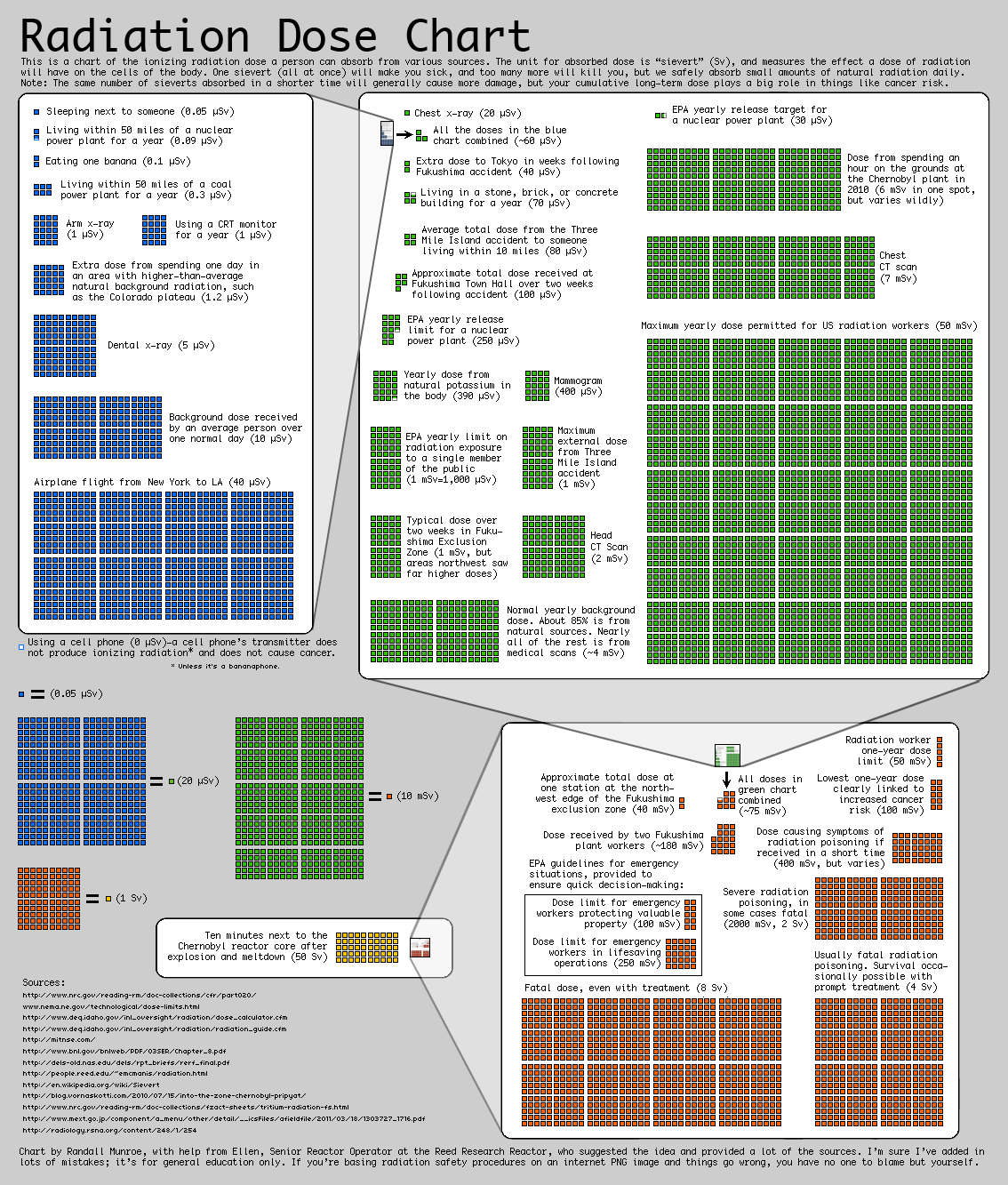
The reports from eschatological finance site Zero Hedge on the Fukushima nuclear disaster's aftermath make instructive reading. For instance, today's report that tens of trillions of Becquerels have spilled into the Pacific:

... and moments ago reality struck again, when the Nikkei newspaper reported that readings of tritium in seawater taken from the bay near the crippled Fukushima nuclear plant has shown 4700 becquerels per liter.
Tens of trillions of Becquerels! nearly 5000 per liter of seawater! the end is nigh.

Anyone know what a Becquerel is? One Bq is defined as the activity of a quantity of radioactive material in which one nucleus decays per second:

For example, natural potassium (40K) in a typical human body produces 4,000 disintegrations per second, 4 kBq of activity.
Heaven forfend! The most radioactive measured water near Fukushima is 70 times as radioactive as normal people!

Who's the original source for this? Why, it's Russian government funded TV station Russia Today.

Russia Today also reports:

The level of radiation at the site [of a highly contaminated leak] was estimated at 100 millisieverts per hour, while the safe level of radiation is 1-13 millisieverts per year, according to ITAR-TASS news agency.
Well, 4 mSv per year is the natural background dose so one can only imagine where ITAR-TASS is getting its data. US radiation workers are allowed 50mSv per year. The contamination level described would likely be fatal if sustained over a day or two, but then it's still 1/100th the level of radioactivity of some trans-uranic waste from US reactors. I wonder why RT wouldn't put this into the proper context?

Now why might the Russian government, drawing substantial economic and political power from its oil and gas exports, want to put a downer on nuclear power? More interestingly, why might Zero Hedge want to support the aims of the Russian government?

Update: (2013-08-21)
Lewis Page at El Reg points out that the 100mSv is beta particles, so you'd have to splash around in or drink the water for it to have any effect. Gamma is 1.5mSv/hr, which means a nuclear worker can work around the water for four 8 hour shifts before approaching their annual radiation limit.

2013-02-12

Coke - it's the real arrhythmia

Personal responsibility has reached a new low where a New Zealand woman, Natasha Harris, who drank 18 pints of Coca-Cola per day mysteriously died.

Yes, you read that right. 18 pints. For reference, if you drank that much fresh water daily you'd be at serious risk of euvolaemic hyponatremia a.k.a. too much fresh water excessively diluting the sodium in the body. So if you're going to drink anything at a rate of 18 pints per day, Coke - or indeed beer - is a far better choice than water. That does not, however, make it a good idea.

Consuming 18 pints of caffeinated sugar solution has its problems. Coke has about 34mg of caffeine per 12 oz, which is about 55mg per pint (assuming imperial pints); that's about 1g of caffeine per day. This is well under the mean lethal dose of 200mg/Kg body weight but equivalent to about 8 cups per day. 1 pint of Coca-Cola has about 65g of sugar so Ms. Harris was consuming well over 1Kg of sugar per day. I'm staggered that she didn't fall into a diabetic coma within a couple of weeks of starting this diet.

I'm sure that Ms. Harris was advised by her nearest and dearest that this wasn't a good idea, surely?

[Her partner] Mr Hodgkinson told the court that she had been unwell up to a year before her death, including vomiting six times a week, but they believed it was caused by the stress of looking after her eight children and gynecological problems.
...
'I didn't ever think about the Coke. I never considered it would do any harm to a person. It's just a soft drink, just like drinking water. I didn't think a drink's going to kill you,' he said.
As we saw, water is even more dangerous. But she had lost all her teeth to the drink, went "crazy" whenever she couldn't get it - couldn't someone who cared for her actually get her to stop?

Mr. Hodgkinson did try to take action, but his timing and direction were not helpful:

Coca-Cola confirmed it had hired a security firm to shadow its staff, after Mr Hodgkinson allegedly made death threats against the company before she died. He rejected claims he had made the threats, but said he held the company responsible for Harris' death.
<bangs head on table>. Mr. Hodgkinson, you were having to throw away four empty 2.5L bottles of Coke every single day. How could you and Ms. Harris not be aware that this was not normal, and really bad for both you?

2013-02-11

OMG the radioactivity will kill us all!

Via Tim Worstall at Forbes we learn that "there is no safe level of radiation":

STOP DEPT OF ENERGY PLANS to dump 14,000 tons of radioactive scrap metals into the manufacturing of consumer products. There is no safe level of radiation. Keep nuclear waste out of my home and workplace!
Maureen Headington, the contact for this petition, comes from Burr Ridge, Illinois. A quick Google indicates that she has radioactive waste under her bonnet, but other forms of energy are in her sights:
The segment features an interview with Maureen Headington who organized this campaign to call attention to the health and environmental hazards from old coal-fired power plants.
and her Stand Up/Save Lives campaign isn't keen on ozone either:
For the past 8 years I have worked as an unpaid volunteer attending city council and village board meetings, with a campaign of public education called "Stand Up/Save Lives"
One can only imagine the hundreds of sighs as she stood up: "Oh no, it's Maureen again..."

If Maureen is curious about the dangers of radiation, I'm sure she is familiar with Tokaimura and Goiâna where, respectively, 10+ Sieverts within a few minutes killed workers but 3+ Sieverts was survivable, and 4.5+ Grays was fatal but 1-4 Grays was survivable. Ms. Headington is concerned about material with a peak radioactivitity of 10 micro-Sieverts per year. That is, one hundred millionth of the radioactivity required to kill a worker at Tokaimura. By contrast, the fatal dose of cyanide is 1.5 mg/kg body weight (105mg for a 70Kg human) and apple pips contain 0.6mg of cyanide so you need fewer than 200 apple pips to kill you. Yet I don't see Ms. Headington clamouring to ban apples - yet.

2013-01-29

In defence of cats

The feline haters are getting organised: they now have an article in Nature Communications (registered media only) arguing that cats are merciless killers and should be put on a leash:

Cats are one of the top threats to US wildlife, killing billions of animals each year, a study suggests. The authors estimate they are responsible for the deaths of between 1.4 and 3.7 billion birds and 6.9-20.7 billion mammals annually.
Well, heck, let's not do any maths on this, Rebecca Morelle from the BBC. Let's just quote the press release verbatim. Heaven forfend that we actually perform any journalism.

Being less lazy than Ms. Morelle, let us assume we have one domestic cat to every household in the USA; it's not going to be exact, but the right ballpark as many cat owners have multiple cats. That's about 100 million cats, and a buttload of wrecked next-door gardens. If they averaged 1 victim a day, that's 36 billion victims. The authors therefore are complaining about cats killing at a rate of 0.1 birds per day and, say, 0.6 mammals per day. I mean, this is not extravagant - you're talking a bird every couple of weeks. Frankly, I don't think most of these cats are trying. A cat who previously owned me used to waste 2-3 mammals and 1 bird per day, and those were only the ones whose remnants I found.

I should confess an interest at this point - I am a cat person (I wash in my own saliva) and can't stand the eager-to-please dependency of dogs. I actually appreciate cats' inclination to hunt and kill mice and rats. For that, I'm fine with them taking the occasional bird or rabbit. While we're here, I'm doubtful about the cats blamed for squirrel deaths - squirrels are nimble, wary and vicious little bastards, and it would have to be a pretty hard cat to kill squirrels successfully in any great numbers. Birds have a massive advantage over cats in being able to fly - although I'm sure the cats are working on that deficiency - and so many birds caught by cats were stupid to descend to the cat's level and likely had it coming.

To give you an idea of the angle of the article, author Pete Marra appears to work in the Migratory Bird Center of the Smithsonian Conservation Biology Institute. I'm guessing he quite likes birds. But, Pete, how many birds are there in the USA? Best guess is 10-20 billion. Life expectancy of songbirds in the USA is under a year so cats are by no means the primary killer of birds - maybe 20% of bird fatalities are due to cats. Presumably many of these are the incautious or stupid ones. We should also note how sparsely populated the USA is; there are vast swathes of land that have very few humans and even fewer cats, but plenty of birds. There's no danger of birds going extinct through cat predation.

So, Dr. Marra, where now?

Dr Marra said: "We hope that the large amount of wildlife mortality indicated by our research convinces some cat owners to keep their cats indoors and that it alerts policymakers, wildlife managers and scientists to the large magnitude of wildlife mortality caused by cat predation."
I wouldn't be surprised if this chap was a vegan, judging by the self-righteous aversion to creature mortality he displays. But no, Dr. Marra, we will not be putting bells on our cats. We will not be locking our cats in the house. We will let our cats do what they will, controlling pests and culling the weak and sick from the bird population.

And when the collapse of civilisation comes, as it surely must, Dr. Marra's most likely fate is to disappear under a pack of hungry cats intent on chewing his face off. No more than he deserves.

2013-01-25

How to run a political campaign like you want to win

The Obama campaign wrote a document "Inside the Cave" documenting their perception of the reasons that their online campaign was (unarguably) so much more successful than Romney's "Project Orca" team.

For me, the key takeaways that emerge from the presentation on why they won:

  • Four times as many resources, people, targets than the GOP campaign;
  • A massive focus on analytics, which the GOP apparently ignored;
  • Recruiting individual credentialed tech staff rather than political wonks and entire corporations (Microsoft in the case of the GOP) for the technology campaign;
  • Pitching technical jobs as undesirable ("It won't pay very well. The hours are terrible ... Most people who come to work here will take a pay cut.");
  • Dynamic daily reallocation of campaigning resources based on per-state simulations;
  • Daily calling of a large number of randomised voters in key states with short questionnaires to obtain data to feed the simulations;
  • Tracking "persuadeability" for voter groups to determine whether it was worth trying to convince them to switch/stay with voting intent;
  • Use of off-the-shelf open-source software such as R for stats analysis;
  • Tracking and categorising Twitter accounts to gauge reaction to local and national political events;
  • Greater online fundraising (which I don't think was a big deal - the campaign was going to spend money whether or not it had it, since it would backstopped by the major unions and private contributors);
  • Using the mail subject line "Hey" (which I'd bin out of hand, but then I wasn't a USA election voter...)
  • Invoking Michelle Obama's name in an email would reduce the amount raised by it;
  • Never mind gut feeling for selecting strategy - use hard data;
  • Allow people to store credit card info on central website but donate from mobile views via a button click, facilitating "drunk donation";
  • Multi-step pages for donations were less off-putting than single-page large forms;
  • Recruit experienced devs from major Silicon Valley social media companies (Facebook, Twitter, Google);
  • Developing tools earlier in the campaign cycle than they actually did would have improved their campaign efficiency;
  • Prepare and drill for the worst (major regional outages) so that when it happens you won't have problems, and you'll have a runbook telling you what to do so you just have to react, not try to problem-solve;
  • Use large-scale hosting and content distribution (AWS, Akamai) to obtain well-managed distributed hardware and robust connectivity so you only have to worry about your apps;
  • Program backends in Python and associated frameworks (Django, Flask) for rapid development
  • Strong presence on social media posting frequent and interesting (reshareable) content;
  • Target heavy online and TV ads spend in key states, age, gender, racial sectors.

I don't think it's too much to say that Obama's "Project Narwhal" spanked Romney's "Project Orca" in terms of efficiency and efficacy. Orca appears to have been a relatively traditional software and system development, using major technology vendors and consultants rather than dedicated individuals, and produced the result that anyone who has worked with large companies on a business-critical system has experienced - farce. This is ironic, as Orca typifies the Big Government approach to solving a problem, whereas Narwhal was a very libertarian project - find motivated people, give them a cause and let them work out what to do. It appears that any major companies involved in Orca quickly ran for cover after Romney's defeat; no surprise there.

Cameron and Miliband should be taking notes if they actually intend to win the next UK election. Following in the steps of Narwhal would seem to be critical to winning the social information war that modern elections are becoming.

2012-12-04

Good news about the change to the UK laws of succession to the throne

Despite the Daily Mail publishing possibly the most stupid article in the world about the royal pregnancy and possibility of twins, the most relevant story about the royal succession is that gender is no longer a determining factor. This resolves a long-standing ambiguity and potential for constitutional crisis - what if the royal baby were a hermaphrodite? Under the old succession laws, the order of succession would have been ill-defined. Now that gender is irrelevant, a hermaphrodite royal can succeed in the same order as a male or female. I expect that's a weight off everyone's mind.

Probability and the TSA

The motto "Be careful what you ask for, you might just get it" is one that TSA IT Strategy Branch Chief Russell Wooten might usefully consider. His request for "ideas on how the Transportation Security Administration (TSA) can improve its capabilities in utilizing its current security technology, upgrading its security technology, or improving its security processes?" landed in the inbox of Sommer Gentry who is a maths professor at the US Naval Academy. Her advice for Mr. Wooten bears careful study. For instance, the explosive screening swab test:

Using Bayes' Rule, we can calculate that even if explosives detection technologies were nearly perfect: catching every actual explosive and only falsely alarming on one in every ten thousand passengers, then only one out of five million positive test results actually indicates presence of an explosive device.
At that level of false positives, the screeners will rapidly lapse into a belief that every alert is a false positive, and let the real bad guys through. Oops! Still, surely backscatter body scanners (AIT) make some contribution to safety, despite slowing passenger progress through security checkpoints?
A recent RAND study of airport vulnerabilities at LAX concluded that "small, portable explosives have been the most likely and most lethal means of attacks at airports" and that "The greatest risks for casualties for most types of attacks are in the high-density areas passengers encounter before reaching the security checkpoint, particularly lines for ticketing and for passing the security checkpoint." Thus, AIT is not only ineffective, it is actually dangerous because it leaves passengers waiting in long lines vulnerable.
Oh. Maybe not.

One is left wondering whether the security theatre of the TSA has actually succeeded in deluding the TSA itself into thinking that it is defending air passenger safety, when all it appears to do is inconvenience passengers and call that "deterrence from attack". It certainly doesn't catch any actual bad guys - the Underwear Bomber avoided TSA scrutiny by the simple expedient of starting from Amsterdam and aiming to detonate his bomb over USA airspace. Mind you, I wouldn't have been surprised if he had managed to go through backscatter scanning without raising any alarms.

2012-11-29

We're all going to drown

The BBC reports that the global sea level is rising and we're all going to die:

The study's headline conclusion is that the polar ice sheets have overall contributed 11.1mm to sea level rise but with a "give or take" uncertainty of 3.8mm - meaning the contribution could be as little as 7.3mm or as much as 14.9mm.
14mm a year! That's over 5.1 meters per century! Vast areas of low-lying land will be inundated! We're all doomed!

Oh, wait:

Another author, Dr Hamish Pritchard of the British Antarctic Survey, said: "The next big challenge - now that we've got quite a good understanding of what's happened over the last 20 years - is to predict what will happen over the next century."
So it's 14mm (worst case) over 20 years. 70 mm (7 cm) in a century. Whoop-de-doo. Can we please put the myth of catastrophic sea rise to bed?

I particularly liked the comment:

The findings are in line with the broad range of forecasts in the 2007 assessment by the UN's Intergovernmental Panel on Climate Change.
In 2007 they had 15 of the 20 years of data already, and they were trying to forecast the final 5 years. Colour me unimpressed. Forecast 20 years in the future with reasonable accuracy, and maybe we'll listen. What does "broad range" mean, anyway? Presumably not "claimed range"?

2012-11-20

Why is helium now so expensive?

With one of the last remaining Zeppelin operators closing its doors due to rising helium costs, you might wonder why helium is so expensive in the first place when we've been happily filling party balloons with it for the past 15 years at rock-bottom prices.

As you might guess, government is involved:

Though new private helium production plants are set to come online in the coming years —including a Wyoming plant expected to open later this year — private industry hasn't been as interested in producing helium as Congress hoped. Until more companies begin producing helium on their own, consumers are left with spiking prices and tightening supplies.
Under the federal system, those prices are unstable partly because they have less to do with supply and demand than they do about the need for the government, under the U.S. Bureau of Land Management, to pay off the cost of creating the Federal Helium Reserve
Because most of the world's helium is produced in the USA (principally Texas) the US Government gets to set helium prices, and for the past 15 years those prices have been low in an attempt to get rid of the US Federal Helium Reserve - currently around 10bn cubic feet of helium. Now that the US Government has to pay off the multi-$bn cost of creating the reserve in a fairly short time, prices have to spike. Nice one.

I knew helium was produced by uranium and thorium decay, but didn't realise that many natural gas fields contain reclaimable helium. Neither did I realise that escaped helium doesn't just go up to the atmosphere - it is so light that it escapes Earth entirely. So reclaiming it from the atmosphere is out.

For those arguing for greater Government involvement in industrial planning, consider what a mess has been made of an effective near-monopoly position in helium which has no effective substitute in many of its uses.

2012-10-18

Is the infantry role out of reach for women?

US Marines Captain Katie Petronio provides some much-needed hard data about how tough combat is on a woman's body:

"By the fifth month into the deployment, I had muscle atrophy in my thighs that was causing me to constantly trip and my legs to buckle with the slightest grade change," she wrote. "My agility during firefights and mobility on and off vehicles and perimeter walls was seriously hindering my response time and overall capability."
Note that this is not just some fainting flower - she's a Marine officer and a standout athlete. But her body just couldn't handle the prolonged physical stress of combat.

This is not to say that women don't have a place in combat. Leigh Ann Hester, Michelle Norris MC and Kate Nesbitt MC all prove that courage and good physical reactions under fire are not the exclusive preserve of men. Sgt. Hester in particular demonstrated an ability to fire, manoeuvre and bring the fight to the enemy with the best of them. However, Captain Petronio's point is a harder one. No matter what our fighting instinct and transient physical reactions show, it seems that even the toughest woman's body degrades over time faster than men in a comparable position.

Is this a good enough reason to keep women out of front-line infantry roles? Beats me. I certainly can't see it as a good argument for keeping women out of armoured fighting vehicles, for instance - but for any role involving extreme physical endurance, it seems that a woman's body can't tolerate prolonged abuse as much as a man's.

2012-07-31

An observation on Chinese medals

Looking at China's medals so far, they are performing best in the swimming and weightlifting. Swimming rewards tall, muscled competitors. Weightlifting rewards squat, broad competitors. Neither of these are matches for the typical short, slender Chinese physique. By contrast: shooting, fencing, diving are natural matches for the 100% focus on medal-winning training that China promotes.

If there were an Olympic medal for undetectable doping, my opinion is that China would be a shoe-in for the gold.

2012-07-25

This would really tick me off

According to the Daily Mail (and if you can't trust them, whom can you trust?) some tick bites can cause the victim to become allergic to red meat. Strewth.

There's a particular irony here:

Experts traced the delayed allergic response to bites from a tick - specifically the Lone Star tick.
The Lone Star tick, presumably from the Lone Star State - Texas - famed for steaks the size of your dinnerplate. I have a horrible thought - is this the result of some fiendish genetic manipulation by the cows on whom the ticks normally prey? Mark Wadsworth, please call your office.

2012-06-26

The Baltic Sea USO - what's going on?

That's Unidentified Seabed Object, just to be clear. So I've been following the earlier Daily Mail articles about this strange rock formation on the bed of the Baltic, thinking "yeah, yeah, Face on Mars territory." Except that now it seems that there's an additional wrinkle:

Professional diver Stefan Hogerborn, part of the Ocean X team which is exploring the anomaly, said some of the team's cameras and the team's satellite phone would refuse to work when directly above the object, and would only work once they had sailed away.
He is quoted as saying: 'Anything electric out there - and the satellite phone as well - stopped working when we were above the object.
Now, let me say that my immediate working hypothesis is that Stefan is enjoying screwing around with credulous journalists. However, just supposing that he's reporting the actual facts, what's going on?

I think the most likely explanation involves the Soviet Navy; there's a long history of Cold War submarine activity with seabed-crawling Soviet mini-submarines, and the Swedish Navy depth-charging them. Maybe, just maybe this artefact is the result of some mid-1980s activity that buried Soviet (nuclear?) hardware under rocks and sand, broadcasting a significant RF signal for some as yet unknown purpose. The Russians are unlikely to admit any involvement unless actually confronted with the retrieved device.

Or maybe aliens crashed their spaceship into the sea, and this expedition will retrieve it. I've seen the second X-Files movie, and know that this never turns out well. Time to go short of Sweden?

2012-05-22

There is a word for people like Elizabeth Moon, and it's not just "idiot"

She thinks that everyone should be given a unique barcode at birth because that would make it easier to identify anyone. She's correct in that assertion, but really struggles to connect this to "and therefore this is a good idea":

Having such a unique barcode would have many advantages. In war soldiers could easily differentiate legitimate targets in a population from non combatants.
This could prevent mistakes in identity, mistakes that result in the deaths of innocent bystanders.

Yes. Um. So you take the population database and run a filter to set the "innocent" Boolean field appropriately, distribute that database to all weapons in the field, and everyone's happy.

For someone who's a science fiction author and History BA, Elizabeth Moon sure didn't pay much attention in the important history classes.

2012-03-15

Mutant mammoths

Oh lordy, they're at it again. Russian scientists plan to resurrect mammoths by injecting mammoth DNA into elephant ova. This DNA has been hanging around since the woolly mammoth went extinct several thousand years ago. What could possibly go wrong?